
Introduction
Many students struggle with managing their time. Between lectures, assignments, exams, and personal life, it can feel overwhelming to stay productive. One simple but powerful method that can help is time blocking.
Time blocking is a productivity technique where you divide your day into specific blocks of time and assign each block to a particular task. Instead of multitasking or working randomly, you focus on one task at a time.
This guide explains how students can use time blocking to study better, stay organized, and achieve daily productivity.
What Is Time Blocking?
Time blocking is a time management strategy where you schedule your entire day into blocks dedicated to different activities.
For example:
. 7:00 – 8:00 AM → Morning routine
. 8:00 – 10:00 AM → Study session
. 10:00 – 10:30 AM → Break
.10:30 – 12:00 PM → Class or reading
Instead of a long to-do list, your calendar becomes your plan for the day.
Why Time Blocking Works for Students
Time blocking is especially helpful for students because it helps them:
1. Reduce Distractions
When you assign a task to a time block, you focus only on that task.
2. Improve Concentration
Studying one subject at a time improves understanding and retention.
3. Avoid Procrastination
When a task has a scheduled time, it becomes easier to start.
4. Manage multiple Subjects
Students usually have many courses. Time blocking allows you to allocate time for each one.
5. Create Study Discipline
Following a schedule builds strong study habits over time.
How to Start Time Blocking (Step by step)
Step 1: List Your Daily Tasks
Write down everything you need to do in a day:
. Attend lectures
. Study
. Complete assignments
. Exercise
. Rest
This helps you understand how your time is used.
Step 2: Estimate Time for Each Task
Next, decide how long each activity will take.
Example:
. Studying → 2 hours
. Assignment → 1 hour
. Reading → 45 minutes
Be realistic to avoid overloading your schedule.
Step 3: Create Time Blocks
Divide your day into time blocks and assign tasks.
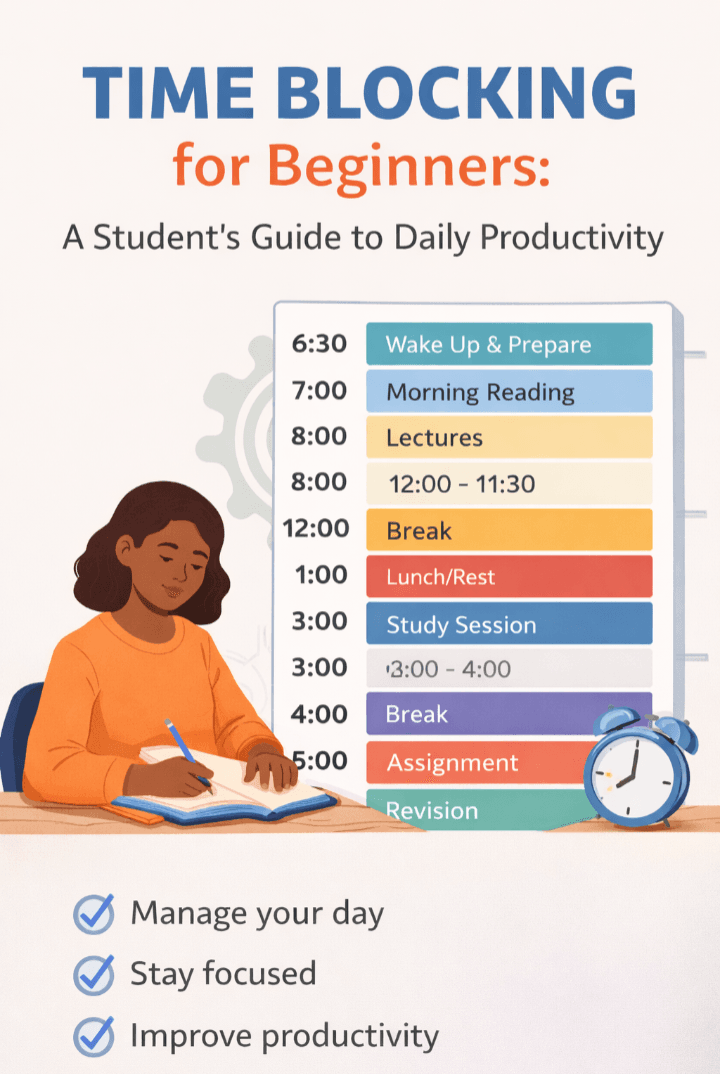
Example student schedule:
. Time Task
6:30 – 7:00
. Wake up and prepare
7:00 – 8:00
. Morning reading
8:00 – 12:00
. Lectures
12:00 – 1:00
. Lunch and rest
1:00 – 3:00
. Study session
3:00 – 4:00
. Break
4:00 – 6:00
. Assignment work
7:00 – 9:00
. Revision
Step 4: Include Breaks
Breaks help the brain recover and stay focused.
You can follow the 50–10 rule:
. Study for 50 minutes
. Rest for 10 minutes
Step 5: Review Your Day
At the end of the day, review your schedule:
Ask yourself:
. Did I follow my time blocks?
. Which tasks took longer?
. What should I improve tomorrow?
Daily reflection helps you improve productivity.
Best Time Blocking Tips for Students
1. Start Small
Begin with 3–5 time blocks per day so the schedule does not feel overwhelming.
2. Use a Planner or Calendar
You can use:
. Google Calendar
. Notion
. A physical notebook
3. Prioritize Important Tasks
Schedule your most difficult subjects when your energy is highest.
4. Avoid Multitasking
Focus on one task per time block.
5. Stay Flexible
If something unexpected happens, simply adjust the next block.
Common Mistakes Students Should Avoid
. Overloading the Schedule
. Trying to schedule too many tasks leads to burnout.
. Ignoring Breaks
. Continuous studying reduces concentration.
. Not Tracking Time
Without tracking time, it is difficult to improve productivity.
. Being Too Rigid
Schedules should guide you, not stress you.
Benefits of Time Blocking for Academic Success
Students who use time blocking often experience:
. Better time management
. Improved study consistency
. Reduced stress during exams
. Higher productivity
. Stronger academic performance
By organizing your day intentionally, you can achieve more results with less stress.
Conclusion
Time blocking is one of the simplest productivity techniques students can adopt. By planning your day into focused blocks of time, you can manage your studies, reduce procrastination, and build powerful study habits.
Start small, stay consistent, and adjust your schedule as you grow. Over time, time blocking can transform how you study, learn, and succeed academically.
Frequently Asked Questions
1. What is time blocking for students?
Time blocking is a planning method where you divide your day into specific periods and assign each period to a particular activity. For example, you might block 8:00–10:00 AM for classes, 2:00–3:00 PM for assignments, and 7:00–8:00 PM for revision.
2. How does time blocking help students?
Time blocking helps students decide when they will work on important tasks instead of simply writing down what they need to do. It can make your day more organized, reduce distractions, and help you stay focused on your priorities.
3. How do I start time blocking as a beginner?
Start by writing down your fixed activities, such as classes, meals, sleep, and appointments. Then add blocks for studying, assignments, revision, personal activities, and rest. Don’t try to schedule every minute of your day when you’re just starting.
4. How many hours should a student study using time blocking?
There is no specific number of hours that every student should study. Your study time depends on your course load, deadlines, energy level, and other responsibilities. Focus on studying consistently and effectively rather than simply studying for many hours.
5. Can I use time blocking if my class timetable changes frequently?
Yes. Time blocking does not have to be rigid. Keep your fixed commitments in your schedule and move flexible study blocks whenever your timetable changes.
6. What should I do if I miss a schedule time block?
Don’t give up on your entire schedule. Simply move the task to another available time or decide when you can realistically complete it. Your time-blocking schedule should be flexible enough to handle unexpected situations.
7. Is time blocking better than making a to-do list?
They serve different purposes. A to-do list tells you what you need to do, while time blocking helps you decide when you will do it. Using both together can make your study routine more organized.
8. Can time blocking help me stop procrastinating?
Yes. Time blocking can make procrastination easier to manage by giving a task a specific time in your day. Instead of saying, “I will study later,” you can decide, “I will study from 7:00 PM to 8:00 PM.”
9. Should I include breaks in my time-blocking schedule?
Yes. Breaks are important. Include time for meals, rest, exercise, personal activities, and sleep instead of filling your entire schedule with schoolwork.
10. Can I use time blocking on my phone?
Yes. You can use your phone’s calendar, reminder app, notes app, or another planning tool. You don’t need an expensive productivity app to start time blocking. A simple notebook and pen can also work.
11. What is an example of a time-blocking schedule for a student?
A simple student schedule could look like this:
6:30–7:30 AM — Wake up, prepare and have breakfast
8:00 AM–12:00 PM — Classes or lectures
12:00–1:00 PM — Lunch and rest
1:00–2:30 PM — Assignment or coursework
2:30–3:00 PM — Break
3:00–4:30 PM — Reading and revision
5:00–6:00 PM — Personal activities
7:00–8:00 PM — Review what you learned
8:00–9:00 PM — Dinner and relaxation
10:30 PM — Prepare for bed
12. What is the biggest mistake beginners make with time blocking?
One common mistake is creating an unrealistic schedule with no room for breaks, delays, or unexpected responsibilities. Start with a simple schedule and adjust it as you learn what works best for you.
13. Can time blocking work for students who also have a job or side hustle?
Yes. Time blocking can help you separate your academic work, job or business activities, personal responsibilities, and rest. This can make it easier to manage several responsibilities without neglecting your studies.
14. Do I have to follow my time-blocking schedule perfectly?
No. The goal is not to create a perfect timetable. The goal is to give your day structure and help you focus on your priorities. Think of your schedule as a guide, not a prison.
15. What is the best time-blocking method for beginners?
Start simple. Identify your most important tasks, assign realistic blocks to them, include breaks, and review your schedule at the end of the day. As you become more comfortable, you can adjust your blocks to suit your study habits and daily routine.
Deja un comentario