
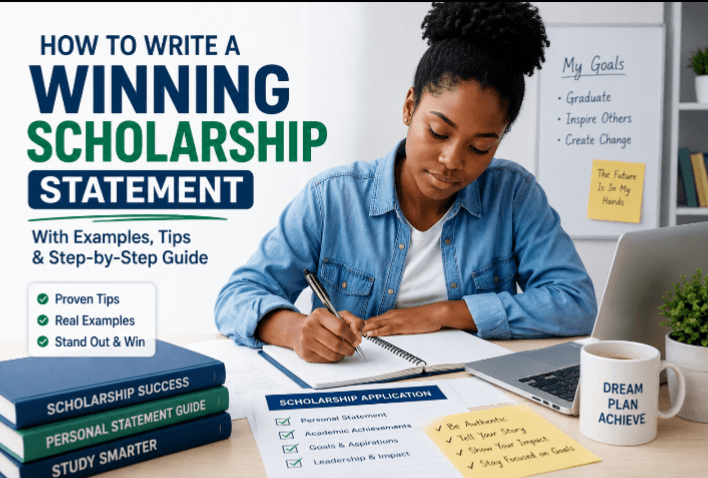
Thousands of students apply for scholarships every year with excellent grades, impressive achievements, and strong recommendations. Yet many applications are rejected because of one overlooked document – the scholarship statement.
A scholarship statement (sometimes called a personal statement or motivation letter) is your opportunity to show the scholarship committee who you are beyond your grades. It tells your story, explains your goals, and demonstrates why you deserve financial support.
If you’ve already found genuine scholarship opportunities, the next step is learning how to present yourself effectively. (You can also read our guide on How to Spot Fake Scholarship Opportunities before applying to avoid scholarship scams.)
What Is a Scholarship Statement?
A scholarship statement is a short essay explaining:
Who you are
. Your academic journey
. Your career goals
. Financial challenges (if relevant)
. Why you deserve the scholarship
. How the scholarship will help you
Unlike a CV, this document allows the committee to understand your personality, determination, and future plans.
Why Scholarship Statement Matter
Many applicants have similar academic records.
Your scholarship statement helps reviewers answer one important question:
“why should we choose you instead of hundreds of other applicants?”
A genuine, well-written story often has more impact than simply listing achievements.
Step 1: Start With a Strong Introduction
Capture attention immediately.
Instead of writing:
“My name is John and I am applying for this scholarship.”
Try something memorable:
“Growing up in a family where paying school fees was a yearly struggle taught me to value education more than anything else.”
The goal is to make the reader want to continue.
Step 2: Tell Your Story
Share experiences that shaped you.
Discuss:
. Your educational journey
. Challenges you’ve overcome
. Leadership experiences
. Community service
. Academic achievements
. Be honest.
Authenticity is more powerful than exaggeration.
Step 3: Explain Your Goals
Scholarship providers invest in people who have direction.
Answer questions like:
. What do you want to become?
. Why did you choose your course?
. How will your education benefit others?
Show that the scholarship is an investment, not just financial assistance.
Step 4: Explain Why You Need The Scholarship
If financial need is part of the criteria, explain it respectfully.
Avoid sounding entitled.
Instead, explain how receiving the scholarship will remove barriers and help you focus on achieving your goals.
Step 5: End With Confidence
Finish with gratitude and optimism.
Example:
“Receiving this scholarship would allow me to continue pursuing my education while preparing to contribute meaningfully to my community. Thank you for considering my application.”
Scholarship Statement Example
Example 1
“Education has always represented hope in my family. Although financial challenges have often threatened my academic journey, they have strengthened my determination rather than weakened it. Studying Computer Science has given me the skills to develop practical solutions for everyday problems. With this scholarship, I will continue building those skills while creating opportunities for others in my community.”
Common Mistakes to Avoid
❌ Copying essays from the internet
❌ Writing generic statements
❌ Ignoring the scholarship instructions
❌ Using poor grammar
❌ Making unsupported claims
❌ Waiting until the deadline
Tips for Writing a Strong Scholarship Statement
. Write naturally.
. Be specific.
. Use real-life examples.
. Proofread several times.
. Ask someone to review your essay.
. Follow the required word count.
Before You Submit
Ask yourself:
✔ Does my essay answer the scholarship question?
✔ Does it sound like me?
✔ Have I explained my goals clearly?
✔ Have I checked for grammar and spelling mistakes?
If your answer is yes, you’re ready to submit.
Reflexiones finales
A winning scholarship statement isn’t about using big words or writing the longest essay. It’s about telling a genuine story that demonstrates your potential, determination, and future impact.
Many scholarship providers receive thousands of applications. A thoughtful, authentic personal statement can help yours stand out.
While preparing your applications, remember to verify every opportunity carefully. Read our guide on How to Spot Fake Scholarship Opportunities to avoid scams, and if you’re still searching for funding, explore our articles on Top Scholarships Students Can Apply for This August, 50 Legitimate Scholarships Every Student Should Bookmark, and 10 Legit Scholarships and Grants Nigerian Students Should Know for more verified opportunities.
Preguntas frecuentes
How long should a scholarship statement be?
Most scholarship statements are between 500 and 1,000 words, but always follow the scholarship’s guidelines.
Can I use the same scholarship statement for every application?
You can use the same foundation, but tailor it to each scholarship’s requirements.
Should I mention financial difficulties?
Yes, if the scholarship considers financial need. Be honest and explain how the scholarship will help.
Is a scholarship statement the same as a motivation letter?
They are similar, although some scholarship providers have different formatting requirements.
Deja un comentario