
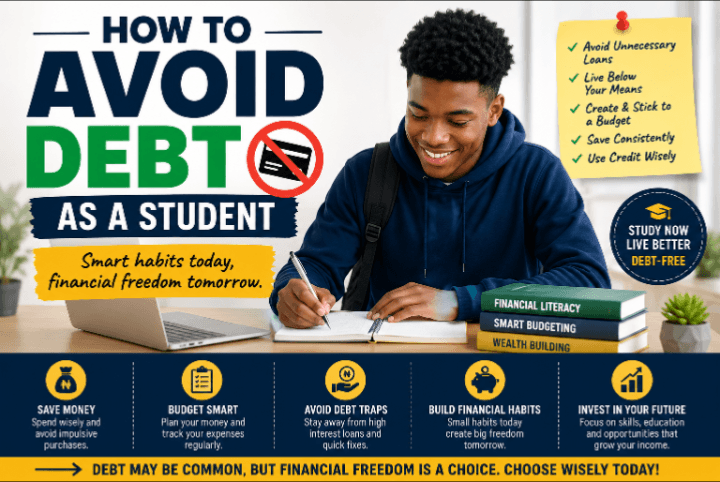
The good news? You can go through school without borrowing money or owing friends.
This practical guide will show you how to avoid debt as a student and stay financially responsible throughout your academic journey.
1. Understand Your Financial Reality
The first step to avoiding debt is knowing:
. How much money you receive monthly
. How much you spend
. What your essential expenses are
Write down:
. School fees
. Feeding
. Transport
. Data
. Accommodation
. Personal care
When you understand your financial situation clearly, you will stop spending emotionally.
2. Create a Simple Student Budget
Budgeting is not for rich people. It is for disciplined people.
Follow this simple format:
. Income – Expenses = Balance
Divide your money into categories:
. 50% – Essentials (feeding, transport, handouts)
. 30% – Flexible expenses (data, personal items)
. 20% – Savings
Even if your income is small, saving something prevents future borrowing.
3. Avoid Lifestyle Pressure
Many students go into debt trying to:
. Impress friends
. Buy expensive phones
. Wear trending clothes
. Attend every outing
Remember: School is temporary. Debt can follow you for years.
Live according to your pocket, not according to social media.
4. Build an Emergency Fund
Unexpected expenses will always come:
. Medical issues
. Urgent handouts
. Project materials
. Family emergencies
If you don’t have savings, you will borrow.
Start small. Even saving ₦500 or ₦1,000 weekly makes a difference.
5. Develop a Digital Skill
One major reason students fall into debt is having only one source of income.
Learn skills like:
. Graphic design
. Video editing
. Copywriting
. Social media management
. Blogging
. Smartphone photography
You don’t need capital to start , you need skill.
When you earn small but consistent income, borrowing reduces drastically.
6. Avoid Buy-Now-Pay-Later and Unnecessary Loans
Some loan apps target students because they know students are vulnerable.
Avoid:
. Quick online loans
. Borrowing for fashion
. Borrowing for flexing
. Borrowing to fund relationships
Only borrow if it is for something productive and necessary , and even then, be cautious.
7. Track Your Spending Weekly
Many students don’t know where their money goes.
At the end of every week, ask:
. What did I spend money on?
. Was it necessary?
. Could I have avoided it?
This habit alone can cut your spending by 20–30%.
8. Learn to Say No
You must learn to say:
. I don’t have money for that.”
. Maybe next time.”
. It’s not in my budget.”
Saying no today protects your peace tomorrow.
9. Cook More, Eat Out Less
Buying food daily is expensive.
If possible:
. Cook in bulk
. Share cooking expenses with roommates
. Avoid unnecessary snacks
Small savings daily prevent big debt later.
10. Think Long-Term
Before spending money, ask:
. Will this matter in one year?
. Is this helping my future?
. Am I spending because of pressure?
Students who think long-term rarely fall into debt.
Common Causes of Student Debt in Nigeria
. Poor financial planning
. Peer pressure
. Lack of savings
. Depending only on allowance
. Impulsive spending
Avoid these traps and you’ll stay ahead.
Reflexiones finales
Avoiding debt as a student is not about having plenty of money. It is about discipline, planning, and smart decisions.
Start small. Save consistently. Spend wisely. Learn skills.
Your future self will thank you.
Deja un comentario