
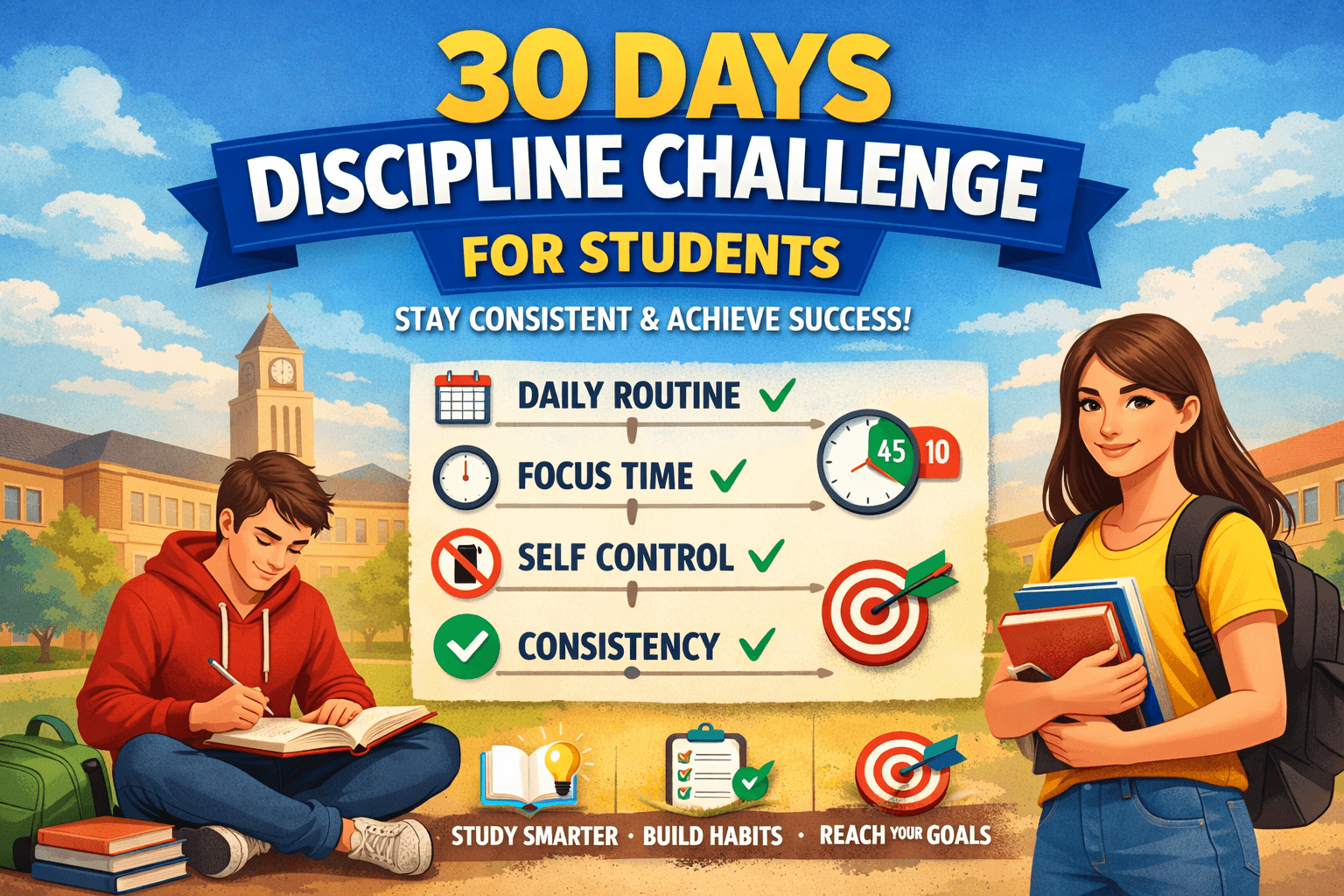
Discipline is one of those things that sounds simple until you actually have to practise it every day.
As a student, you may have good plans on Sunday and still find yourself scrolling through TikTok, chatting on WhatsApp, or postponing your assignment by Wednesday. It does not always mean you are lazy. Sometimes, you simply have no clear system to help you stay consistent.
That is why I created this 30-day discipline challenge for students.
Instead of telling you to suddenly become a “perfect” student, this challenge focuses on small actions you can repeat every day. The goal is to improve your study habits, reduce distractions, manage your time better, and become more consistent with your academic goals.
You do not need to change your whole life in one day.
You only need to start with Day 1.
What Does Discipline Mean for a Student?
Student discipline is not about punishing yourself or studying for ten hours every day.
It is about learning to do the things that matter even when you are not in the mood.
For example, discipline can mean:
. Studying before spending hours on social media
. Completing an assignment before the deadline
. Attending lectures even when you feel tired
. Keeping track of important school activities
. Going to bed at a reasonable time before an early class
. Saying no to distractions when you have an important task
Motivation can help you start, but discipline helps you continue when the excitement disappears.
Why Do Many Students Struggle With Consistency?
There are several reasons students find it difficult to stay disciplined.
1. They depend too much on motivation
You may feel motivated today and decide to study for three hours. Tomorrow, that motivation may disappear.
A better approach is to create a routine that you can follow even when you don’t feel highly motivated.
2. Social media takes more time than expected
You may open your phone just to check one message and suddenly discover that an hour has passed.
Apps such as TikTok, Instagram, Facebook and WhatsApp can easily become distractions when you are supposed to study.
3. They set unrealistic goals
If you normally study for 30 minutes and suddenly decide to study for eight hours every day, you may quickly become tired and give up.
Start with something realistic and increase it gradually.
4. They don’t have a clear plan
“I’m going to study today” is not a complete plan.
A better plan is:
A better plan is:
“I will study History from 5:00pm to 6:00pm and revise two topics.” Setting meaningful goals can also make it easier to stay focused on what you want to achieve.
Your 30-Day Discipline Challenge
This challenge is divided into four stages.
Week 1: Build structure
Week 2: Improve your focus
Week 3: Develop self-control
Week 4: Build consistency
You don’t have to be perfect. If you miss a day, don’t quit the entire challenge. Simply continue the next day.
Week 1: Build Your Structure
Day 1 – Write Down Your Main Goals
Write down three things you want to improve during these 30 days.
For example:
. Improve my grades
. Study consistently
. Reduce unnecessary phone use
Keep the list somewhere you can see it.
Day 2 – Set a Wake-Up Time
Choose a realistic time to wake up and try to follow it.
You don’t have to wake up at 5:00am just because someone online says successful people do.
Choose a time that works with your school schedule.
Day 3 – Create a Simple To-Do List
Write down only three important tasks for the day.
For example:
- Attend lecture
2. Read one chapter
3. Complete assignment
Don’t fill your list with twenty tasks you know you won’t finish
Day 4 – Clean Your Study Space
Remove unnecessary things from the place where you study.
A clean environment can make it easier to concentrate
Day 5 – Create a Study Time
Choose a specific time of the day for studying.
It could be:
5:00pm–6:00pm
or
7:00pm–8:00pm
The exact time matters less than consistently showing up
Day 6 – Reduce Phone Distractions
Before studying, put your phone on silent or airplane mode.
If you need your phone for schoolwork, turn off unnecessary notifications.
Day 7 – Review Your First Week
Ask yourself:
. What worked?
. What distracted me?
. What did I fail to complete?
. What can I improve next week?
Don’t insult yourself for mistakes. Use them to improve your plan
Week 2: Improve Your Focus
Day 8 – Try the 45/10 Study Method
Study for 45 minutes and take a 10-minute break.
During the 45 minutes, focus on one task.
If 45 minutes feels too long, start with 25 minutes.
Day 9 – Study One Subject at a Time
Avoid jumping between several subjects every few minutes.
Choose one subject and give it your attention.
Day 10 – Put Your Phone Away
Don’t keep your phone beside your book if you don’t need it.
Put it somewhere you cannot easily reach.
Day 11 – Study in a Quiet Place
Find a place where you can concentrate.
It could be your room, library, reading room, or another quiet place.
Day 12 – Stop Multitasking
Don’t try to study while watching videos, chatting and scrolling through social media.
Give your brain one main job at a time.
Day 13 – Finish One Difficult Task
Choose one task you have been avoiding and complete it.
Sometimes discipline simply means finally doing the thing you have been postponing.
Day 14 – Review Your Focus
Write down the biggest distraction you experienced during the week.
Then decide what you will do about it next week.
Week 3: Build Self-Control
Day 15 – Start Before You Feel Ready
Don’t wait until you “feel like studying.
”Start with just 10 minutes.
Once you begin, continuing often becomes easier.
Day 16 – Complete an Assignment Early
If you have an assignment due later in the week, start today.
Avoid waiting until the night before submission.
Day 17 – Control Your Social Media Time
Set a specific period for social media.
For example:
8:00pm–9:00pm
Outside that period, focus on your important tasks.
Day 18 – Say No to One Distraction
Choose one unnecessary activity you normally spend too much time doing and reduce it today.
Day 19 – Keep a Progress Record
Write down what you studied and how long you studied.
You don’t need a complicated app.
A notebook is enough.
Day 20 – Do Something You Have Been Avoiding
Maybe it is reading a difficult topic, organizing your notes, completing an assignment or contacting someone about an academic issue.
Do it today.
Day 21- Review Your Self-Control
Ask yourself:
“Am I becoming better at doing what I planned?”
You don’t need to be perfect. Look for improvement.
Week 4: Turn Discipline Into a Habit
Day 22 – Plan Tomorrow Tonight
Before sleeping, write down the three most important things you need to do tomorrow.
This saves you from waking up without direction.
Day 23 – Protect Your Study Time
Treat your study period like an important appointment.
Don’t give it away unnecessarily.
Day 24 – Review Your Weakest Subject
Spend some time working on a subject or topic you normally avoid.
Improvement often starts where we are weakest.
Day 25 – Take Care of Your Sleep
Try to get enough sleep.
Staying awake all night every day is not a good definition of discipline.
A tired student may struggle to concentrate and remember what they study.
Day 26 – Reward Yourself
After completing your important tasks, give yourself a small reward.
It could be watching a movie, playing a game, listening to music or spending some time online.
The important thing is to reward yourself after doing the work.
Day 27 – Clean Up Your Notes
Organize your notes, files and important school materials.
This can make revision much easier later.
Day 28 – Think About Your Progress
Compare your habits now with how you behaved on Day 1.
Ask:
. Am I studying more consistently?
. Am I wasting less time?
. Am I managing my phone better?
. Am I completing tasks earlier?
Day 29 – Create Your Personal Routine
Based on what you have learned during the challenge, create a routine that you can realistically continue.
Don’t copy someone else’s routine exactly.
Create one that fits your school, responsibilities and lifestyle.
If you’re struggling to build a consistent morning routine, you may also find our guide on creating a simple morning routine helpful.
Day 30 — Review the Entire Challenge
Congratulations. You have completed 30 days.
Now write down:
Three habits I want to keep:
One habit I need to improve:
My next academic goal:
The challenge is not really about reaching Day 30.
The real goal is to build habits that continue after Day 30.
What If You Miss a Day?
This is important.
Do not quit because you missed one day.
Missing one day does not destroy your progress.
The dangerous thought is:
“I already failed, so I might as well stop.”
Instead, tell yourself:
“I missed yesterday. Today I continue.”
Consistency does not mean doing everything perfectly. It means returning to the plan when you fall off.
A Simple Daily Routine for Students
You can create your own routine, but here is a simple example:
Morning
. Wake up
. Get ready for school
. Check your priorities for the day
During school
. Attend lectures
. Take useful notes
. Ask questions when you don’t understand something
After school
. Rest briefly
. Eat
. Review what you learned
Evening
. Complete assignments
. Study one or two important topics
. Prepare for tomorrow
Before bed
. Check what you accomplished
. Write tomorrow’s three priorities
. Put your phone away and get enough rest
Your routine doesn’t have to look exactly like this.
The best routine is one you can actually maintain.
How to Stay Disciplined After the 30 Days
Finishing the challenge is only the beginning.
To maintain your progress:
Keep your goals visible
Write your main academic goal somewhere you will see it regularly.
Continue using a to-do list
Three important tasks are often better than a long list you cannot finish.
Schedule your study time
Don’t leave studying completely to chance.
Control your phone
Your phone is a useful tool, but it can also become one of your biggest distractions.
Review your week
Take five or ten minutes at the end of each week to see what worked and what didn’t.
Don’t compare your progress with other students
Someone else may study for six hours while you study for two productive hours.
Focus on improving your own consistency.
Benefits of Developing Discipline as a Student
Good discipline can help you:
. Study more consistently
. Complete assignments earlier
. Reduce last-minute exam pressure
. Manage your time better
. Reduce unnecessary distractions
. Become more confident
. Develop better habits
. Make steady progress toward your academic goals
Discipline will not make every school day easy.
You will still have stressful days, difficult subjects and moments when you don’t feel motivated.
The difference is that you learn how to keep going.
Frequently Asked Questions
How can I become more disciplined as a student?
Start with small habits. Choose a fixed study time, create three daily priorities, reduce distractions and track your progress. Don’t try to change everything overnight.
How many hours should a student study every day?
There is no single number that works for everyone. Your course, academic level and schedule matter. Instead of focusing only on hours, focus on having regular and productive study sessions.
What should I do if I lose motivation?
Don’t wait for motivation to return before taking action. Start with a small task, such as studying for 10 minutes or completing one question. Action can help rebuild momentum.
How do I stop my phone from distracting me while studying?
Turn off unnecessary notifications, use airplane mode or Do Not Disturb, and keep the phone away from your study area when you don’t need it.
Can I restart the 30-day challenge if I fail?
Yes. But you don’t always need to restart from Day 1. If you miss a day, simply continue the next day and learn what caused the interruption.
Is discipline more important than motivation?
Motivation is useful for getting started, but discipline helps you continue when motivation becomes low. Both are useful, but building a routine makes consistency easier.
Final Thoughts
You don’t need to become a completely different person in 30 days.
You only need to become a little more consistent than you were before.
If you study when you planned to study, complete an assignment before the deadline, put your phone away when you need to concentrate and keep returning to your goals after difficult days, you are already building discipline.
Don’t wait for the perfect Monday.
Don’t wait for a new semester.
Start with today.
Day 1 begins with one small decision.
Leave a Reply